
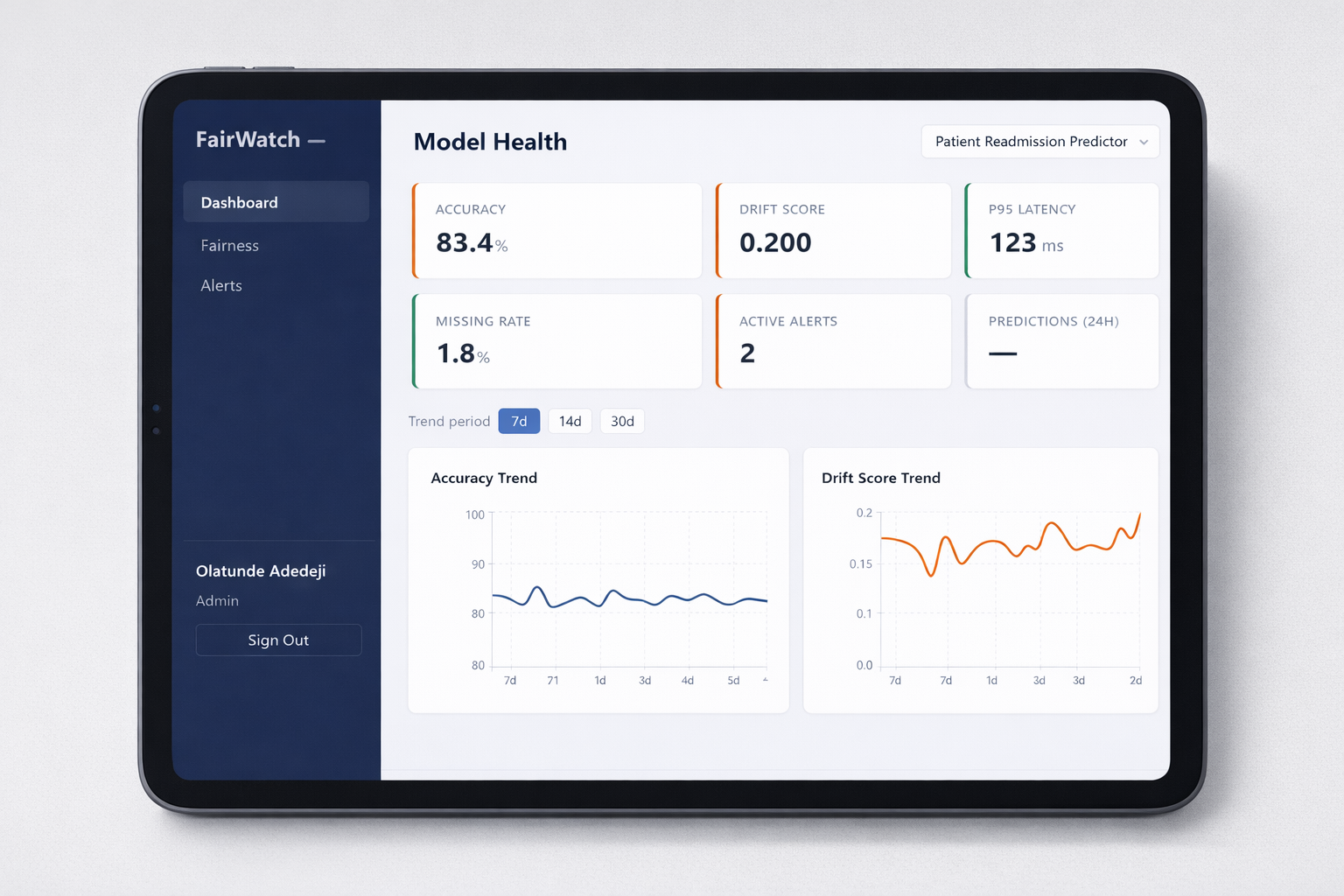
Healthcare teams already monitor many parts of model behavior. They watch latency, uptime, missing data, prediction volume, and top-line performance because those signals affect whether a system can be trusted inside real clinical workflows. But one signal is still too often treated as a document-time concern instead of a run-time concern: fairness. In healthcare, that separation should be risky. A model can remain fast, available, and accurate on average while becoming less reliable for specific patient groups, and that gap can carry consequences for care quality, triage, and follow-up decisions. Recent reviews in medical AI argue that unfairness can emerge from data, labeling, model development, and deployment context, and that those disparities can directly undermine equitable care.
Here, I am focusing on AI fairness in practice, not just theoretical compliance. The practical question is no longer just, Was this model evaluated for bias before launch? The harder and more useful question is, Can we see subgroup harm early, respond to it clearly, and preserve the response history when a deployed model starts behaving unevenly? That shift matters because post-deployment environments are dynamic. Patient populations change. Clinical workflows evolve. Upstream data pipelines drift. What looked acceptable during validation can become less fair in production, even when aggregate performance appears stable. Papers on fairness drift and post-deployment clinical AI monitoring make this point directly: ongoing surveillance is needed to track performance, safety, and equity over time.
Moving beyond fairness as documentation
The model card tradition helped the field by normalizing transparent reporting. Mitchell et al. argued that models should be accompanied by documentation describing intended use, evaluation procedures, and performance across relevant demographic or intersectional groups. That was an important step because it pushed teams to disclose more than one headline metric. But documentation alone is not monitoring. A model card can tell you how a system behaved at evaluation time. It cannot tell you whether false negative rates are widening this month for uninsured patients, or whether a drift event is disproportionately affecting one age band today.
This is the gap I wanted to address through the FairWatch work: treating subgroup performance as a live operational signal rather than a release-time appendix. The underlying principle is simple and worth stating plainly:
A model that performs well on average but harms a subgroup is not a healthy model.
That statement sounds obvious, but many monitoring setups still do not act like they believe it. They present global accuracy, drift, and latency, while subgroup behavior stays buried in separate evaluation notebooks or occasional governance reviews. In healthcare, this creates false comfort. A green dashboard can hide a systematically worse experience for a vulnerable population. Reviews of fairness in clinical AI emphasize that these disparities are not edge cases; they are a central deployment concern.
Why aggregate metrics are not enough
The practical problem with aggregate metrics is not that they are useless. It is that they compress away the exact detail needed for investigation. A model may hold an acceptable overall accuracy while underperforming for older adults, uninsured patients, or another operationally relevant segment. If a team only sees the average, they may never notice that errors are concentrating in one subgroup until the issue becomes serious.
That is why I prefer segment-level visibility over a single fairness badge. One composite fairness score looks neat, but it rarely tells an operations team where the disparity sits, which type of error is driving it, or what needs investigation. In healthcare, the difference between a false positive disparity and a false negative disparity matters. A false negative disparity in a risk model may mean the patients who need intervention most are the ones less likely to be flagged. Flattening that into one score weakens the signal.
A small snippet from the seeded fairness data shows the idea more concretely. Instead of simulating symmetric, clean behavior, the project intentionally introduced subgroup disadvantages so the interface and workflow had to deal with realistic disparities:
pythonbias_map = {
    ("age_group", "65+"): -0.06,
    ("gender", "non-binary"): -0.04,
    ("insurance_type", "uninsured"): -0.08,
    ("insurance_type", "medicaid"): -0.05,
}
That choice matters because design quality improves when the development environment contains realistic asymmetry. If the data already contains subgroup penalties, the monitoring layer has to expose them, the alerting layer has to classify them, and the incident workflow has to make them actionable. Otherwise, the dashboard is only proving that it can visualize clean data.
Treating fairness like a monitoring concern
The architecture behind this work is intentionally simple in concept. There is a monitoring layer for overall health signals, a fairness layer for subgroup metrics, an alerting layer for threshold breaches, and an incident workflow layer for ownership and response. I like this separation because it keeps the system legible. Monitoring metrics answer questions like, Is the model drifting? Fairness metrics answer questions like, Who is being affected differently? Alerts translate those conditions into operational signals, and the workflow layer answers, Who saw this, who picked it up, and what happened next?
At the schema level, the most important design choice is the one that preserves subgroup context:
pythonclass FairnessMetric(Base):
    segment_name = Column(String(100), nullable=False)
    segment_value = Column(String(100), nullable=False)
    accuracy = Column(Float)
    error_rate = Column(Float)
    false_positive_rate = Column(Float)
    false_negative_rate = Column(Float)
That structure avoids hardcoding one protected attribute or one reporting view. It lets the system track fairness by age group, gender, insurance type, or another clinically meaningful segment using the same pattern. More importantly, it keeps fairness disaggregated all the way through storage and retrieval. That is what makes investigation possible later.
This matches the direction of the literature. Model cards argue for evaluation across groups relevant to the intended domain, and recent healthcare fairness reviews stress that subgroup disparities may appear differently across contexts and populations. The technical takeaway is straightforward: if fairness matters operationally, the data model must preserve the dimensions that make unfairness visible.
Building for subgroup visibility, not just subgroup storage
Storing subgroup metrics is not enough by itself. Teams need ways to ask three practical questions:
- What segment types exist for this model?
- How is each segment performing right now?
- How has that performance changed over time?
That is why the fairness layer exposes separate endpoints for history, segment discovery, and latest comparison. One route returns fairness time series, another returns available segments, and another returns the most recent cross-segment snapshot. That decomposition keeps the API composable and keeps the frontend honest. Each view answers one operational question clearly rather than overloading a single endpoint.
The frontend then computes the spread between the best- and worst-performing segment to make the disparity impossible to miss:
javascriptconst accuracies = barData.map((d) => d.accuracy);
const maxGap = accuracies.length > 0
  ? (Math.max(...accuracies) - Math.min(...accuracies)).toFixed(1)
  : 0;
I like this because it does not make the user mentally subtract bars in a chart to estimate the size of the problem. It pulls the gap into the interface as a first-class signal. If that gap crosses a chosen threshold, the UI can flag it immediately. This is one of the broader lessons I took from the project: responsible AI is also an interface design problem. If the evidence of subgroup harm is hard to find or hard to compare, the system is technically fair-aware but operationally weak.
Why alerting matters for fairness
Monitoring without response is only observation. A team may notice a fairness gap, discuss it briefly, and then lose the context in chat threads or screenshots. That is why I think incident workflow belongs in fairness operations, not just in reliability operations. If a subgroup disparity matters enough for presentation, it should be worth addressing and resolving.
The alert structure in this work uses one model for both technical and fairness-related signals. Drift, latency, missing rate, and fairness gap all move through the same lifecycle. That choice is deliberate. It puts fairness on the same operational footing as the issues teams already treat as production-grade concerns.
A seeded example makes the point:
python{
    "metric_name": "fairness_gap",
    "threshold": 0.05,
    "actual_value": 0.08,
    "severity": "critical",
    "status": "active",
}
This is small, but conceptually important. The fairness issue is not buried in a report. It is an active operational event with severity, status, and workflow. Once the response layer supports acknowledgment and notes, the system begins to preserve institutional memory rather than just present anomalies.
The route that updates alert status captures that accountability:
pythonif payload.status == "acknowledged":
    alert.acknowledged_by = current_user.email
    alert.acknowledged_at = datetime.utcnow()
That server-side attribution matters because it prevents the response record from being optional or informal. In healthcare-facing AI settings, reviewability matters. Post-deployment monitoring frameworks and algorithmovigilance discussions both argue that healthcare AI needs more structured oversight after deployment, not less. The operational implication is that fairness alerts should leave an audit trail.
Designing the dashboard around operational reading
A fairness-aware system should not force users to stitch together five disconnected surfaces to understand what is happening. The dashboard should support fast operational reading: current health, subgroup risk, alert state, and recent trends. In this work, the summary API computes the latest metric snapshot, active alert count, and recent prediction volume server-side so the interface can load a useful operational view quickly.
The client then renders KPI cards that classify signals as good, warn, or bad, rather than presenting every value neutrally. That may seem like a small design choice, but it changes how teams read the system. The interface takes a position. It says drift is acceptable, borderline, or concerning. Active alerts are normal, elevated, or bad. The same principle should apply to fairness signals. Operational AI fairness becomes easier to act on when the system does more than display raw subgroup metrics; it helps users interpret the posture of the system.
The same design logic applies to trend charts. A subgroup disparity that is widening over time matters differently from one that is stable and already known. Trend views let teams distinguish between a static limitation and an active deterioration. That aligns with recent work calling for continuous monitoring of healthcare AI after scaled deployment so that safety, performance, and equity can be tracked as systems evolve in the real world.
Why healthcare raises the bar
Fairness matters everywhere, but healthcare raises the bar because model disparities can intersect with existing inequities in diagnosis, treatment access, and resource allocation. A recommender system and a clinical risk model may both produce biased outputs, but their consequence structures differ. In healthcare, subgroup underperformance can compound already uneven care pathways. That is why recent reviews in medical AI call fairness a central clinical integration issue rather than a side topic.
This is also why I find purely symbolic fairness language unsatisfying. Responsible AI becomes much more useful when it translates into concrete operational behaviors: storing subgroup metrics, comparing current performance across segments, thresholding disparity, routing alerts, assigning ownership, and preserving the response. Those are engineering choices. They are also governance choices. And they are more helpful than treating fairness as a slide in a launch deck.
What I think practitioners should take from this
Three ideas stand out for me.
First, aggregate performance can create false comfort. If you care about fairness in production, your monitoring design has to preserve the dimensions where unfairness can show up. That means subgroup-aware data models, subgroup-aware APIs, and subgroup-aware UI patterns.
Second, fairness becomes more useful when it is operationalized. Documentation still matters, and model cards remain valuable. But fairness becomes much more actionable when it is tied to dashboards, thresholds, and response workflows instead of static reports alone.
Third, incident workflow belongs in the fairness conversation. If a system can present a subgroup disparity but cannot track who acknowledged it or what changed afterward, the monitoring story is incomplete. In practice, operational fairness needs both visibility and accountability.
Final Thoughts
The core idea here is not complicated: fairness should be treated like a live property of an AI system, not just a launch-time statement about one. In healthcare, that means moving from static fairness reporting toward continuous subgroup visibility, alerting, and accountable response. The technical patterns are not exotic. They are mostly familiar engineering habits applied to a problem teams often leave outside day-to-day operations: structured metrics, layered data models, meaningful dashboards, thresholds, status transitions, and audit trails.
That is why I find operational AI fairness more compelling than fairness as rhetoric. It asks better questions. Who is being affected differently? How do we know? When did it change? Who picked it up? What was done? In a healthcare context, those questions feel closer to what responsible deployment should actually look like.
The full source code for FairWatch is available on GitHub: FairWatch
References
Chen, R. J., et al. (2023). Algorithm fairness in artificial intelligence for medicine and healthcare. Nature Biomedical Engineering. https://pmc.ncbi.nlm.nih.gov/articles/PMC10632090/
Mitchell, M., et al. (2019). Model cards for model reporting. In Proceedings of the 2019 Conference on Fairness, Accountability, and Transparency (FAT* '19). https://arxiv.org/abs/1810.03993
Ng, M. Y., et al. (2024). Scaling equitable artificial intelligence in healthcare. https://pmc.ncbi.nlm.nih.gov/articles/PMC11535661/
Post-deployment monitoring of healthcare AI systems. (n.d.). https://pmc.ncbi.nlm.nih.gov/articles/PMC11832725/
Algorithmovigilance and continuous oversight in clinical AI. (n.d.). https://pmc.ncbi.nlm.nih.gov/articles/PMC11447237/